 Deneb Systems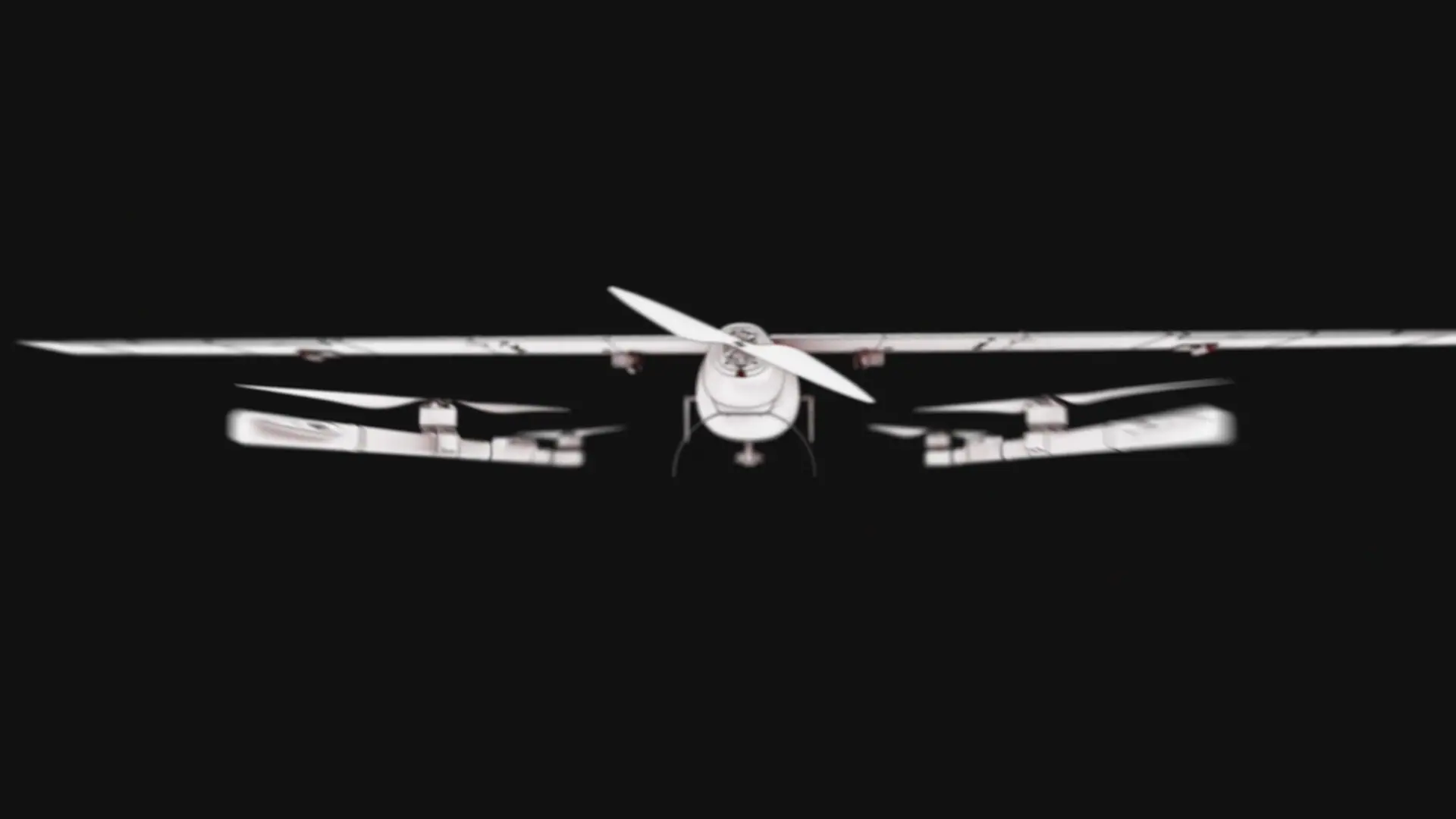
Deneb Systems / Raven
Raven
Defense logistics,
without the runway constraint.
A largely 3D-printed autonomous VTOL aircraft - configurable payloads, resilient autonomy, proven from digital twin to first flight.
- Length
- 2.5 m
- target airframe
- MTOW
- 10 kg
- target
- Flight time
- up to 1.5 h
- development goal
- Mission radius
- 30 km
- early iteration
Deneb Systems / Platform
An autonomous aircraft you can print.
Raven is a fixed-wing VTOL aircraft built to carry configurable payloads and run complete missions on its own. Four vertical-lift motors get it airborne from anywhere; a forward puller motor, ailerons and a V-tail take over for efficient cruise.
The airframe is up to fully 3D printed - advanced UAV development without conventional aerospace manufacturing. Everything below was validated as a full system: a Gazebo digital twin and ArduPilot flight stack first, then a printed airframe and a successful first flight.
01 / Airframe
Airframe configuration.
A clean pass across Raven's complete quadplane configuration - four lift arms, forward puller, and V-tail resolved into a single flight form. This is the working prototype, not a concept render.
~90% to fully 3D printed depending on prototype revision.
System architecture
One aircraft, two flight regimes.
A quadplane: vertical lift for launch and recovery, fixed-wing for range. No runway, no catapult, no recovery net.
Lift & propulsion
- VTOL rotors
- 4× vertical
- Cruise motor
- Forward puller
- Configuration
- Quadplane
Control surfaces
- Roll
- Ailerons
- Pitch / yaw
- V-tail
- Flight mode
- Fixed-wing
Airframe
- Manufacturing
- ~90–100% 3D print
- Length
- ~2.5 m
- MTOW target
- ~10 kg
Mission role
- Primary
- Payload delivery
- Secondary
- Autonomous ISR
- Payload
- Configurable
02 / Propulsion
VTOL propulsion.
Lift-motor and arm geometry shown directly from the current airframe. The quadplane layout separates hover and cruise so Raven can launch and recover vertically, then transition to fixed-wing flight for range.
Configuration studies
Every angle of the prototype.
Digital twin
Tested as a system before it was built.
Raven has a complete Gazebo model used to reproduce real flight and mission scenarios before any physical testing. Gazebo supplies the physics and sensors, ArduPilot SITL flies the dynamics, and ROS 2 connects the camera and perception layer.
It was validated as a full virtual system - four rotors, one puller, aileron and V-tail joints, and simulated camera, IMU, GPS and airspeed - not just a 3D model that looks right.
- Gazebo
- ArduPilot SITL
- ROS 2
- MAVLink
- MAVProxy
- DroneKit
- Python GCS
- Sim camera / IMU / GPS
Perception & autonomy
It keeps flying the mission when the link drops.
Raven is built to run missions without continuous pilot input. Onboard vision handles detection and target tracking; navigation commands go out over MAVLink; a custom ground-control station manages the autonomous mission.
The design intent is resilience: continue after losing the pilot link, operate in GPS-denied conditions using onboard sensors and camera, identify a target, complete the task, and return toward launch within an acceptable positional error.
- Object detection - YOLO / TensorFlow Lite
- Camera-based target tracking & follow
- MAVLink autonomous navigation
- Comms-loss mission continuation
- GPS-denied onboard navigation
- Autonomous return-to-launch
03 / Structure
Serviceable wing system.
The physical wing latch is a real prototype assembly detail - engineered for field service and rapid iteration rather than a rendering claim. Wings come off by hand for transport and repair.
04 / Payload
Modular payload bay.
A full underside view of the current mounting interface. The bay is built to accept configurable payloads, giving procurement teams a direct look at how Raven adapts to a mission rather than a fixed role.
05 / Logistics
Cargo-release system.
Release hardware operating beneath the airframe - the logistics mechanism at the core of the payload-delivery mission. Shown as working prototype hardware, actuated in the current configuration.
Engineering pipeline
Concept to flight, then back again.
A full aircraft-engineering workflow - simulation and physical testing feeding each iteration.
- 01Concept & prototypeInitial aircraft conceptcomplete
- 02CAD & aerodynamicsDesign and airframe developmentcomplete
- 03CFD analysisAirflow-driven design adjustmentscomplete
- 04Gazebo modelAircraft converted to simulationcomplete
- 05ROS 2 + SITLAutonomy and flight-stack integrationcomplete
- 06Vision & autonomyDetection, tracking, navigation logicdemonstrated
- 07Printable airframeDetailed manufacturing preparationcomplete
- 08First flightPhysical build and flight testingdemonstrated
- 09IterationAirframe changes from real resultsongoing
06 / Analysis
Aerodynamic development.
CFD analysis sits inside the iteration loop: airflow over the airframe informs design changes before the next printed revision. Simulation and physical testing feed each other rather than running in isolation.
Technical status
What's proven, and what isn't.
Raven is an early-iteration prototype. Figures below are marked by confidence - we don't publish development targets as production specifications.
| Parameter | Value | Confidence |
|---|---|---|
| Configuration | Fixed-wing VTOL quadplane | verified |
| Airframe process | ~90–100% 3D printed | verified |
| First flight | Achieved, iterating | verified |
| Length | ~2.5 m | target |
| MTOW | ~10 kg target | target |
| Flight time | up to 1.5 h goal | target |
| Mission radius | 30 km early figure | target |
| Cruise / max speed | Not yet verified | unverified |
| Payload capacity | Not yet verified | unverified |
| Propulsion / battery | Not yet verified | unverified |
07 / Field evidence
First flight.
Uncropped vertical field footage of the working flight sequence - the milestone where the digital twin became a flying aircraft. Prototype flight test, followed by continued airframe improvement.
Deneb Systems fleet
Raven doesn't fly alone.
Raven
VTOL payload & mission platform
The larger aerial platform: configurable payload delivery and autonomous missions on a resilient flight-control stack.
Alien
Compact autonomous interceptor
The smaller, vision-guided interceptor UAV - a separate airframe in the Deneb Systems fleet.
View Alien →Sky Tracker
Visual tracking & perception
CPU-efficient visual tracking that can support onboard or ground-based UAV systems across the fleet.
View Sky Tracker →